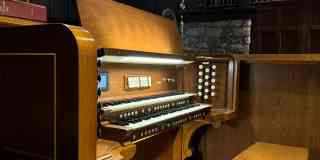

The Organ
Organ music has been an integral element of worship at Holy Trinity Church since the very beginning when in the late 1800’s Mrs. B. F. Cook was “its faithful and efficient organist for many years.”
The current two-manual organ matches the beautiful singing of the parish choir and fills an essential role in the musical and liturgical life of the church.
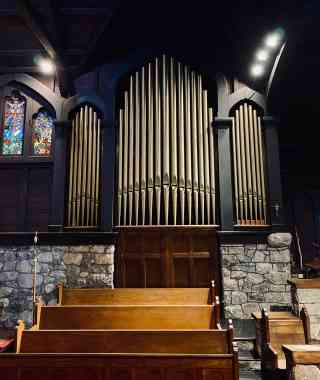
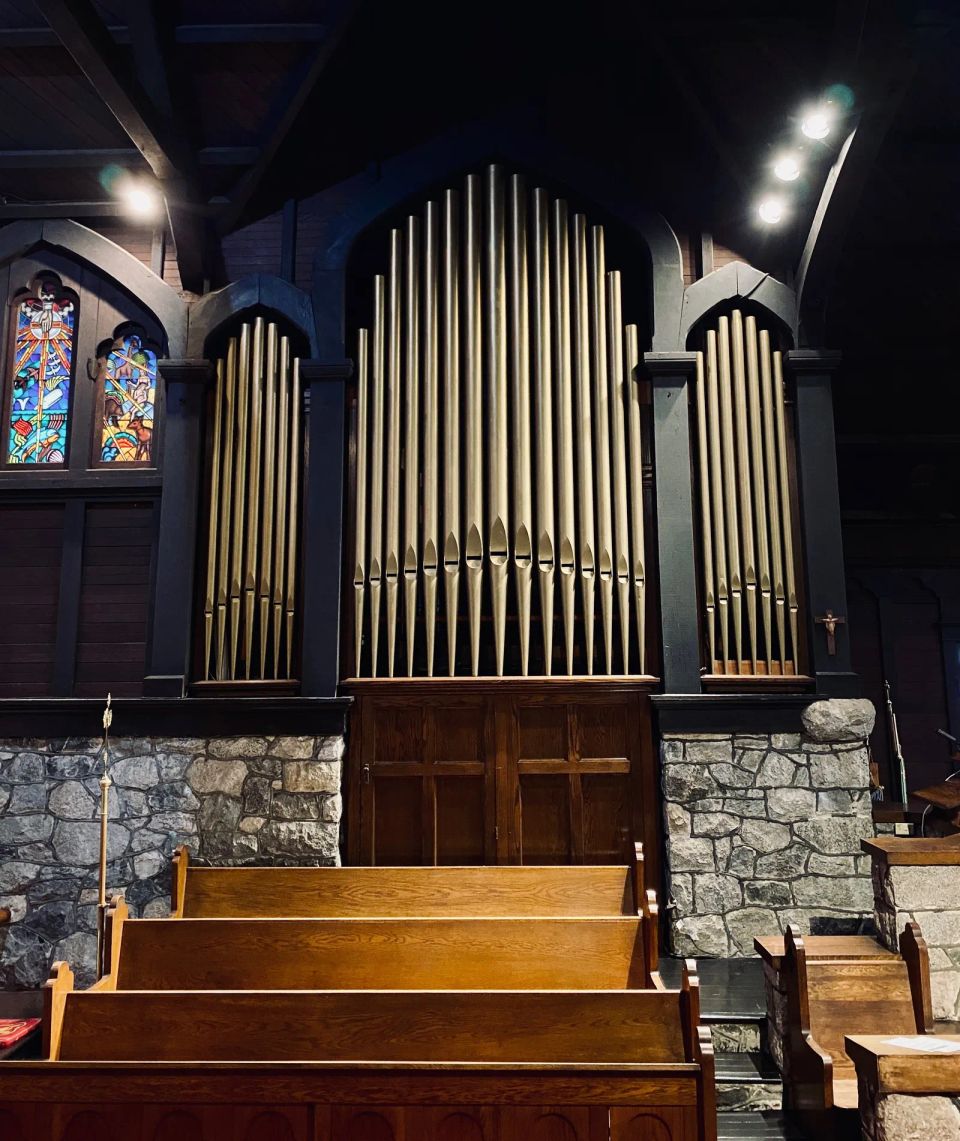
In 1926 a new instrument was installed by the Louisville, Kentucky, organ building firm Henry Pilcher’s Sons. The organ was 11 ranks of pipes, situated on electro-pneumatic, ventil-style wind chests, with a detached console located in the choir. In 1961, the Pilcher console was replaced by one built by the Möller Organ Company of Hagerstown, Maryland. In 2002 O’Neal Pipe Organ Service made some important alterations including several new, custom built, wind chests with newly refurbished pipe work in order to support a wider range of repertoire, both for the accompaniment of choral and congregational music, and solo organ repertoire. When St. Martha’s Episcopal Church (West Covina) was disbanded in 2013, six ranks of the Wicks pipe work were preserved, and an 8′ Diapason is scheduled to be incorporated into the instrument. When completed the instrument will have 34 ranks. The remaining Wicks pipe work can be incorporated into the instrument when funds become available.
In 2017 the church rebuilt the Möller 2-manual draw-knob console and outfitted it with a new solid-state relay system, which includes a multi-level memory combination action manufactured by Syndyne Co. of Vancouver, WA. The new Syndyne system includes the following components:
- MS8400 Solid State Control System
- Touchscreen user interface
- Available USB interface
- MIDI In, Out, Through
- Piston Sequencer
- Integrated playback and record
- Transposer
Specifications
Pedal
11 stops- 32′
- Resultant
- 16′
- Contrabass
- 16′
- Subbass
- 16′
- Bourdonbass (Gt)
- 8′
- Octave
- 8′
- Flute
- 4′
- Choralbass
- 16′
- Posaune
- 16′
- Bassoon (Sw)
- 8′
- Tromba
- 4′
- Oboe (Sw)
Great
12 stops- 16′
- Bourdonbass
- 8′
- Principal
- 8′
- Bourdon
- 8′
- Gross Flute
- 8′
- Gemshorn
- 4′
- Octave
- 4′
- Nachthorn
- 2⅔′
- Twelfth
- 2′
- Fifteenth
- III–IV
- Fourniture 1⅓
- 8′
- Bassoon
- 4′
- Recorder
Swell
15 stops- 8′
- Diapason
- 8′
- Stopt Diapason
- 8′
- Salicional
- 8′
- Voix Celeste (TC)
- 8′
- Erzahlen II
- 4′
- Principal
- 4′
- Harmonic Flute
- 2′
- Flageolet
- II
- Cornet
- III–IV
- Plein Jeu 2′
- 16′
- Bassoon
- 8′
- Trumpet
- 8′
- Oboe
- —
- Tremulant
- 4′
- Swell to Swell
Couplers
8 couplers- 8′ Great to Pedal
- 4′ Great to Pedal
- 8′ Swell to Pedal
- 4′ Swell to Pedal
- 16′ Swell to Great
- 8′ Swell to Great
- 4′ Swell to Great
- 8′ Great to Swell
The 2025 Organ Project: Restoring Our Church’s Voice
Join us in raising $19,000 to renovate the Holy Trinity pipe organ and enrich our worship with renewed splendor.
Dear Holy Trinity community,
As many of you know, Holy Trinity is home to the St. Cecilia Music Guild, which supports our music program. The Guild helps fund musical events, guest musicians, and the care of our instruments. Today, we are officially launching a new project under the Guild’s direction: the 2025 Organ Project.
Our pipe organ is not just an instrument. It’s a living part of our worship. It leads our hymns, supports our choir, and provides music at our most sacred moments: baptisms, weddings, funerals, and feast days. Like any finely crafted mechanical system, though, it requires long-term care.
Over the past few years, the organ’s internal components, especially the leatherwork in the windchests, have begun to fail. These components are now decades old and are reaching the end of their life. If left unaddressed, we’ll continue to see more dead notes, and eventually the organ could fall silent.
What Needs To Be Done
To address this maintenance, we’ve brought in our expert organ technician and former music director, Sean O’Neal, to assess the situation and prepare a renovation plan. His proposal includes:
- Re-leathering the Great and Swell windchests (with nearly 1,050 individual actions),
- Repairing the original wind reservoir,
- And restoring the instrument to full, reliable function, without changing its historic character.
The total cost for this work is $19,000. This kind of restoration lasts 30 to 40 years — thought of like a capital improvement, such as a new roof, it breaks down to less than $1,000 per year over its lifetime. It’s one of the most cost-effective investments we can make for something that serves us every week.
How You Can Help
This project will only move forward with your support. Whether you’re a longtime member or new to Holy Trinity, I invite you to consider giving toward the 2025 Organ Project. Contributions of any amount, either one-time or as part of ongoing support to the St. Cecilia Music Guild, are deeply appreciated.
Thank you for being part of this beautiful community, and for supporting a future filled with vibrant music.
Warmly,
Garrett John Law
Director of Music